A pen in a narrow thigh pocket can undo an otherwise careful load of laundry. Tactical pants need a more thorough preparation check than a simple pair of trousers because storage compartments, adjustable parts and layered knees create more places to overlook. The actual washing decision is usually simpler: follow the garment label, then organize the load so the trousers can wash, rinse and dry properly.
Quick Answer
Use the instructions sewn into your exact pair. Empty every pocket, remove detachable inserts as directed, secure closures and remove loose dirt before washing. Choose the permitted wash and drying process; tactical styling does not justify hotter water, stronger chemicals or a heavy-duty cycle.
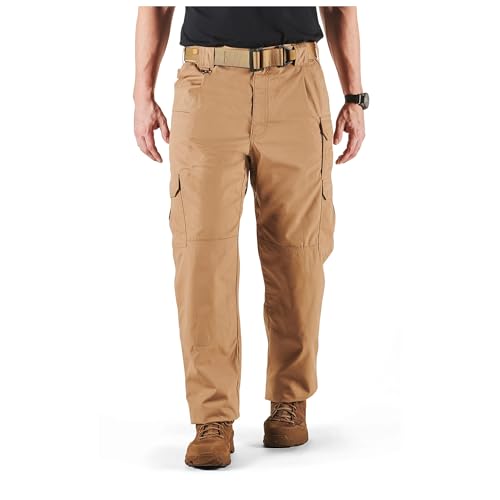
Make one care record for the exact pair
Photograph the care label while its lettering is readable. Include the model identifier, fiber information and any separate instruction for a finish or removable component. Save the pictures together rather than trying to remember which instruction belongs to which black pair. A small phone album is enough; you do not need an elaborate laundry log.
Read the whole instruction sequence before starting. Washing permission does not establish tumble-drying permission, and a permitted drying process does not establish an ironing setting. GINETEX explains these as separate care processes. If the garment has written instructions alongside symbols, use both. A missing label is a reason to ask the manufacturer about the exact style, not to select the toughest cycle because the product name sounds rugged.
Compare versions carefully. An Amazon listing for Helikon-Tex UTP Ripstop identifies a different fabric version from a UTP Denim listing. Likewise, Propper Uniform and Lightweight Tactical are separate models. Their names help you find the right information; they do not allow instructions from one version to stand in for the other. Keep a secondhand pair separate from your established routine until you identify it.
Empty every compartment before laundry
Lay the trousers on a surface and work consistently from waist to hem. Check front pockets, rear pockets, cargo compartments and any smaller sleeves. Feel the bottom corners rather than just looking into the openings. Remove coins, receipts, pens and pocket organizers, then check again from the inside where accessible. An apparently empty opening can hide a small object behind a divider.
Remove the belt. Follow component instructions for knee inserts, removable cords or attachments; a part that can be detached is not automatically machine washable. Set those pieces somewhere you will find them after the pants are dry. Do not force an insert through an opening or cut a retaining stitch to make removal easier.
Prepare soil, closures and seams
Deal with loose soil before it becomes part of the wash load. Gently shake out pocket debris and brush away dry surface dirt without grinding it into the weave. Close the fastenings that the manufacturer directs you to secure and ensure hook-and-loop surfaces meet cleanly. Propper's tactical-clothing care guidance specifically addresses removing belongings, pads and loose debris before washing.
Inspect the seat seam, pocket corners and cuff edges at the same time. A partly detached pocket or caught zipper deserves attention before another cycle. You are looking for a practical reason to pause, not trying to perform a laboratory inspection of every stitch. A quick check is also your chance to identify a stain that ordinary washing may not resolve.
Compare the models discussed
5.11 Men’s Taclite Pro Pants, Propper Men’s Lightweight Tactical Pants
As an Amazon Associate I earn from qualifying purchases. Purchases take place on Amazon.
Build the load around the pants
Sort for compatible care requirements as well as color. A towel load and a load of lightly worn trousers can both look like everyday laundry, yet their textures and requirements differ. Avoid placing an unfamiliar pair into a mixed load simply to fill the machine. On the first wash, keeping its behavior easy to observe can save confusion later.
Leave the machine enough capacity for the selected cycle to work as described in its manual. A drum filled by volume can still contain a dense mass of cargo-pocket layers. If you have to push the door closed against a compressed bundle, reconsider the load. Do not invent a universal number of pairs: machine capacity, garment size and the selected program all affect the decision.
Use a detergent suitable for both the garment and the machine. Measure according to the product directions, taking account of the load and the water conditions specified there. More foam is not a reliable indication of better cleaning. Avoid adding a second product because the pants look more technical than your other clothes.
Fabric softener is not an automatic finishing step. Propper advises avoiding it for its tactical clothing, including because it can coat hook-and-loop surfaces. For other manufacturers, check the specific instructions rather than treating softener as a necessary way to break in the trousers. A new pair that feels stiff requires a fit and fabric assessment, not an improvised softening recipe.
Choose settings in the right order
Start with what the label permits, then select the matching process on your appliance. Temperature, mechanical action and drying are separate choices. A heavily soiled knee does not cancel a gentler-care instruction elsewhere on the garment. Treat the local problem with a compatible method before the main wash rather than exposing the entire pair to a harsher process.
The table below is a decision aid, not a set of universal appliance settings. Its purpose is to keep each choice connected to the information that actually controls it.
| Decision | Information to use | Common wrong shortcut |
|---|---|---|
| Water setting | Exact garment instruction | Assuming workwear needs the hottest wash |
| Cycle action | Care instruction and appliance program description | Equating a ripstop grid with unlimited agitation |
| Detergent amount | Detergent directions and load conditions | Doubling the dose for cargo pockets |
| Drying process | Separate drying permission | Copying the wash temperature logic |
When a stain remains after washing, examine it before routine drying. A second treatment should be chosen for that mark and fabric, not improvised by increasing every setting. Keep the affected pair out of the next general load while you decide what to do. Our stain-removal article covers the distinctions between everyday mud, greasy marks and ink.
Dry the pocket layers, not just the outer leg
Unload promptly and unfold the legs. Check that a pocket bag has not folded into a tight lump and that a turned hem is not retaining debris. Arrange the garment for the drying method its label permits. If you use a drying rack, give the fabric space instead of stacking one pair directly over another.
Do not judge completion solely by touching the broad thigh panel. Check the waistband, cargo-pocket folds, reinforced knees and hems. These are useful inspection locations because several layers can meet there. The point is not to predict an exact drying-time difference between models; it is to avoid putting away a pair while a less visible section is still damp.
When tumble drying is allowed, follow the stated process and remove the trousers when it is complete. When natural drying is specified, use the arrangement required by the label. Do not substitute a radiator, a hot car or prolonged direct sunlight as a shortcut. Finish by returning removable components only after the garment and components are ready for use.
A practical household routine gives the pants a place to finish drying before storage. If one pair must be ready again tomorrow, start early enough to allow the permitted process. An additional suitable pair may be more useful than a complicated sequence of last-minute drying tricks.
Set a useful washing rhythm
Use wear conditions to decide when normal cleaning is needed. A short indoor outing and a day of dusty yard work do not create the same laundry task. Visible dirt, persistent ordinary wear odor and the requirements of your workplace are more useful signals than a made-up rule that every tactical model should be washed after a fixed number of hours.
For a uniform, check the employer's appearance requirements separately from care instructions. The employer can require a clean, presentable pair; that does not mean a home laundering routine should become an invented decontamination method. This guide concerns ordinary clothing care. Unusual chemical contamination is outside its scope.
Make the next purchase easier to maintain. Compare the actual care information for a 5.11 Taclite Pro and a Propper Lightweight Tactical rather than assuming both will fit your current laundry habit. If the garment needs a process you cannot reliably provide, another model may be a better everyday choice even if its pocket layout is attractive.
Frequently asked questions
Can I wash tactical pants with jeans?
Only when the colors, care requirements and load characteristics are compatible. An unfamiliar pair is easier to assess separately. Check for rough hardware, lint transfer and enough room for the selected cycle rather than treating all trousers as one laundry category.
Should cargo pockets be turned inside out?
Inspect and empty them fully. Turn the garment or pocket bags only where the construction and manufacturer instructions allow it; do not strain stitched dividers to expose a corner. The aim is clean, accessible pockets without forcing the fabric.
Do tactical pants need a special detergent?
Not simply because they are called tactical. Use a detergent compatible with the care label, machine and any stated fabric treatment. Some finishes have additional requirements, so identify those before selecting additives.
Final Verdict
A dependable wash begins before the machine starts: identify the pair, empty its storage and follow the complete care sequence. Give layered areas enough opportunity to dry, then store the trousers ready for the next wear. Consistency with those few decisions is more useful than treating rugged-looking clothing as permission for an aggressive wash.
Compare the models discussed
5.11 Men’s Taclite Pro Pants, Propper Men’s Lightweight Tactical Pants
As an Amazon Associate I earn from qualifying purchases. Purchases take place on Amazon.
Sources
Explore the related shopping collection · How our guides are prepared